Tuesday, March 21, 2017

ACRL-VWIG & ALA Virtual Communities in Libraries Program

March 19, 2017  CVL Auditorium in Second Life 12:00pm SLT


“Beyond Basic Social Media: Moving Towards Content Marketing”
 presented by:

Laura Solomon,  (Lebachai Vesta in Second Life) 
Ohio Public Library Information Network


At this month’s ACRL-CVL Meeting, social media expert Laura Solomon, Library Services Manager at the Ohio Public Library Information Network, shared her experiences and offered tips on how to use digital tools to promote library related content in new ways.  Laura is the author of “The Librarian’s Nitty Gritty Guide to Content Marketing” (2016) and “Doing Social Media So It Matters: A Librarians Guide (2010) both published by the American Library Association.
 
Lebachai Vesta

Content marketing for libraries is more than just letting people know what items your library has.  Users need to know what the pay-off is for them to use those materials or to use the library.  Good content marketing is not just promotional material, it should tell your library story.  


To be effective, content marketing in digital media needs to be:

1)     Strategic - has a plan behind it; at fulfilling some need of your user
2)     Relevant - actually be something useful for your intended audience
3)     Targeted -  designed for a particular audience (and need)
4)     Consistent –has to happen on a regular basis
5)     Goals- content is meant to drive a particular action

Before posting to social media, you should ask these 3 questions to make sure you’re about to post something useful:

-Why does this make the library valuable to the chosen audience?
-Was this designed to meet a targeted audience’s need?
-Where can this content best serve people?


When the content that libraries push out in digital media fail to consider these design aspects of effective content marketing,  what happens is they get a reputation for being useless to users,  users show a lack of interest in libraries and their resources, and, in the end, they come to see libraries as having no perceived value.


Laura discussed 4 basic planning stages libraries should consider when designing useful digital content 

-figure out your target audience
-speak to their needs, and interests and address their “pain points”  NOT their roles
-create a single editorial calendar to help plan & visualize your content marketing
-publish in a way that personalizes content, tell a story about it

Follow the 30-70 rule; make 30% of your content about promotion while 70% is about engaging with your audience.


Finally Laura suggested that you “repurpose” whatever content you create.  Create something once and adapt it for posting in other social media sites.  Turn your blog into an info graphic for Pinterest, add hashtags for Twitter, create a teaser and post to Facebook with links back to your library.

Wednesday, February 22, 2017

ACRL-VWIG & ALA Virtual Communities in Libraries Program

February 19, 2017  CVL Auditorium in Second Life 12:00pm SLT

 Mindfulness Meditation Using Basic Second Life
presented by:
 Ewan Bonham and Starlight


For the February 2017 ACRL-VWIG Program, Ewan Bonham and Second Life artist, Starlight met with a group of librarians and educators to provide both an introduction to Mindful Meditation and more specifically, to demonstrate how basic Second Life building skills can be used to enhance and expand the meditation experience for practitioners. At the end of this presentation, he led a tour and demo of the meditative space used by Transformative Action group at the Hikari sim in Second Life.


Ewan first gave a brief overview of Mindful Meditation by reviewing what it is and explaining some of its' basic techniques and practices. Simply said, the goal of mindful meditation is to put oneself in a calm space in which distracting thoughts and feelings are observed nonjudgementally in order to create detachment from them and thus gain insight and awareness of ones' self.

After this overview, he went over how basic Second Life  building skills can be used to make and greatly enhance ones' own personal meditation space.


What followed was a series of demonstrations of various aspects of Second Life building skills that can be used to create and greatly enhance a personal meditation space.  He pointed out that one of the great things about Second Life is that one is able to create a meditative space with a single mouse click.  Either by creating a space and saving it in one's inventory or by teleporting to one of the many  sims that already exist in Second Life.  Briefly, he went over the ways basic Second Life building skills  can be used to enhance and create a personal meditative space. 
With some basic Second Life building tools, one can create an immersive, meditation environment.

Sunrise or sunset mood?


The ability to manipulate one's surroundings and the quality of light was the first technique reviewed.  Second Life gives one the ability to adjust the quality of light in the environment to suit your particular mood or frame of mind.  It can be bright or it could be darker and moodier.

Setting to dusk can help create a quieter mood.
Manipulating the light in Second Life is one of the most powerful tools for directing meditation.

Another powerful tool in the Second Life builders kit is the ability to use textures and colors to create and enhance concentration and the sense of immersion.  This was demonstrated by a series of kinetic art works/color sculptures and settings created bySecond Life kinetic artist, Starlight. 

Kinetic sculpture artist, Starlight who provided the visual works for this demonstration.
In Second Life one is able to create and surround oneself by moving, changing colors and objects that help enhance your meditative state.  These work either by immersing you in a space or by providing an object to focus and reflect on.


These moving objects or sculptures allow the practitioner to concentrate on the space/moment they are in and so help create and promote a stronger meditative state.

Equally powerful is the ability to use visual and verbal affirmations and music and sounds.  All of these are easily manipulated in Second Life with basic building skills.


At the end of his presentation, Ewan told us about an in-world group that meets regularly and offers practical training on how to effectively meditate using the techniques of mindfulness focusing.  This group meets each Sunday at 3pm SLT within Second Life.


 Ewan and Starlight concluded their presentation by taking the group on a tour of the meditation space in Second Life at the Hikari sim.

The Hikari sim is set up to be a totally immersive meditative environment complete with various meditation spaces, music and other interactive spaces.
A more traditional group mediation space.
This space makes use of all the tools in the Second Life builders kit, textures, light, music, sounds and nature scenes to help create a truly immersive and personal meditative space. (photo courtesy of Valibrarian Gregg)
In addition to the group spaces, there are individual spaces for meditation.

All in all this was a powerful demonstration of how Second Life can be used to do things not traditionally considered a part of virtual worlds.

Monday, January 16, 2017


ACRL-VWIG & ALA Virtual Communities in Libraries Program

January 15, 2017  CVL Auditorium in Second Life 12:00pm SLT

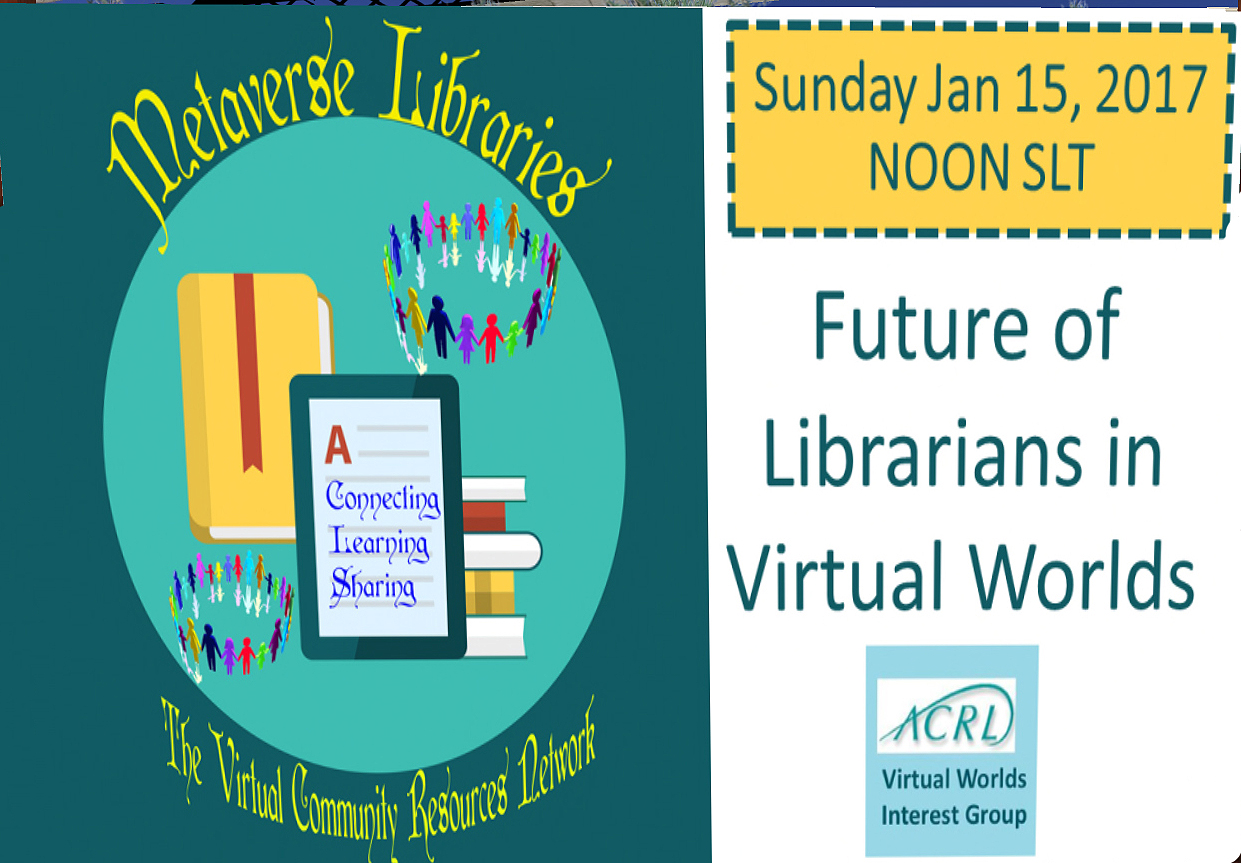
 The Future of Librarians in Virtual Worlds (Metaverse Libraries)
presented by:

 Dr. Valerie Hill (Valibrarian)
and
Dr. Marie Vans (Amavans Lapis), Director of the InWorldz Community Library


For the January 2017 ACRL-VWIG Program, Dr. Valerie Hill and Dr. Marie Vans met with a large group of librarians and educators to provide an overview of the activities of the Community Virtual Library in Second Life and in other virtual worlds.


Val and Marie addressed some of the obstacles educators have using Second Life for classes (steep learning curve, and expense for example), but pointed out that virtual worlds still have great potential for providing avenues for global learning, networking and collaboration.  Most of their presentation focused on the future of Virtual Worlds and specifically on the activities of the Community Virtual Libraries which are aimed at fostering the use of virtual worlds for education.

Dr. Marie Vans (Amavans Lapis) andDr. Valerie Hill (Valibrarian)
Both speakers pointed out that there are as many different communities of users in virtual worlds as there are different virtual worlds.  They emphasized that because of its' popularity, its' advanced level of development and the rich collaborative environment it offers, Second Life continues to be the major venue for those interested in exploring the educational uses of virtual worlds.  While true for the foreseeable future, the Community Virtual Library has begun to focus its' activities on providing information that would help users learn about other virtual spaces.  Toward this end, the CVL has created the "Hypergrid Resource Center".

The Hypergrid Resource Center Building in Second Life
The goal of this center is to help people learn about other virtual spaces and the activities of educators and librarians working in these virtual communities.  The Center aims to help foster collaboration and networking among librarians and educators by providing them with information about other virtual worlds and on the activities of the community of users working in them.
 
To this end, the CVL has begun offering programs and developing in-world resources that highlight the distinct and different advantages each virtual world has as well as their unique community of users.


The focus for the Community Virtual Library has broadened to include not just providing information about Second Life and the activities of educators there, but also to collaborate as a "community of interest".  This allows real learning and sharing of information to take place.  Librarians can serve as community resources, people skilled at providing information about other virtual worlds to educators.  In doing so, they can connect users interested in virtual worlds with different virtual communities just as they currently connect library users with various meta-resources.

The speakers pointed out that other virtual worlds such as Kitely, InWorldz, and OpenSimulator offer some advantages not found in Second Life.  In addition to establishing "branches" of the Community Virtual Library in other metaverses, they also offer programs which highlight the strengths of these different virtual worlds.

The Community Virtual Library branch in Kitley

A CVL program which explored InWorldz, a virtual world which has become a nexus for artists and builders.

A display of interactive Library resources help supplement the InWorldz artists progam.

 Kitely offers a different operating model where virtual resources are less expensive and more readily available to users

The speakers concluded their presentation by examining ways that librarians and educators can be involved in the outreach effort of the Community Virtual Library to help encourage the use of other virtual worlds.  These include:

-Volunteering to provide office hours in-world at the CVL Reference desk in Second Life to help users

- Assisting in the creation of info resources on other virtual worlds for the Hypergrid Resource Center

-Working with CVL librarians educators to help network with professionals in other virtual worlds

-Helping to plan and conduct programs, exhibits and speakers for CVL programs

-Helping to  create and update CVL metaliteracy resources 

-Assisting with writing activities and contests (such as the annual CVL Poetry Contest)

-Volunteering to help update current CVL database-lists such as the list of educational places in Second Life


The speakers concluded by pointing out that virtual worlds still hold far more potential for educators than the coming wave of virtual reality headsets because they allow interaction, networking and collaboration between users while VR headsets work only in isolation and do not allow users to interact with anyone else.